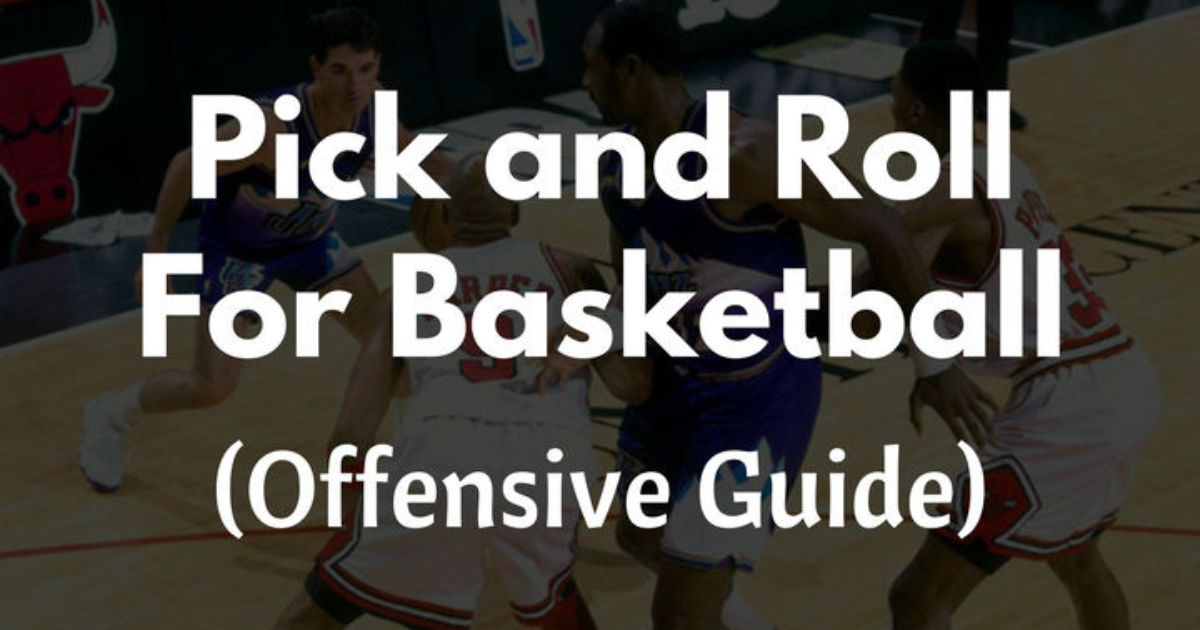
There are few plays in basketball that are as recognizable—or as successful—as the pick-and-roll. It is easy to understand and difficult to stop, and it creates mismatches, scoring angles, and uncertainty in defensive players. Whether it was NBA greats John Stockton and Karl Malone, or the likes of on-court stars like Stephen Curry and Nikola Jokić today, the pick-and-roll is still used by all teams, at every level.
In this article, we will breakdown the execution of the pick-and-roll, discuss some offensive strategies that utilize the pick-and-roll, and then review defenses for combating the pick-and-roll.
How the Pick-and-Roll Works
The pick-and-roll starts when an offensive player (the dribbler) uses a teammate (the screener) to block a defender or “pick” them away. After the screen is set, the screener will “roll” toward the basket (or pop to the perimeter) and this forces defenders to make a quick decision: chase the ball, cover the screener, or rotate help.
This can create a lot of pressure on the defense. If the sequence is executed efficiently, it can create open shots, layups, or mismatches.
Offensive Options with the Pick-and-Roll
-
Classic Roll to the Basket
The screener rolls directly to the hoop after establishing the pick.
- Strengths: Allows for easy finishes for gone big men, and collapses defense.
• Best utilized: When the screener is strong and athletic, and can finish and catch in traffic.
-
Pick-and-Pop.
Instead of rolling the screener takes a step back along the perimeter to shoot a jump shot.
- Strengths: Stretches the defense, and punishes teams who try and close the paint.
- Best utilized: When the screener is a reliable mid-range or three-point jump shooter.
-
Slip Screen.
The cutoff man fakes setting the screen and quickly slips towards the basket before the defender can react.
- Strengths: Puts extra pressure on aggressive defenses that try to hedge or trap and the pick.
- Best utilized: When the defense anticipates the pick-and-roll almost every time.
-
Double Pick-and-Roll (Stacked Screens)
Two players set consecutive screens for the ball handler.
- Strengths: Adds a layer of complication, causing confusion and mismatches.
- Best used: To get elite shooters or crafty playmakers an open shot.
-
Spain Pick-and-Roll (Screen-the-Screener)
A third player sets a back screen on the defender of the original screener freeing up the roll to the basket.
- Strengths: Very effective at the professional level with lobs and wide open three point shots.
- Best used: With good spacing and selfish passers.
Defensive Responses
As great as the pick-and-roll is, it is not unstoppable. Defenses use many different techniques for neutralizing it.
-
Switching
Defenders simply switch assignments.
- Advantages: Neutralizes immediate action and keeps plays in front.
- Disadvantages: Can cause mismatches (like a guard on a big man).
-
Hedging
The screener’s defender steps out momentarily to contain the ball handler, then his back in.
- Advantages: Gives the on-ball defender time to recover.
- Disadvantages: Leaves the screener open for a second on the roll.
-
Trapping (Double-Teaming the Ball Handler)
Two defenders converge on the ball handler to force a turnover.
- Advantages: Disrupts rhythm and puts pressure on weaker ball handlers.
- Disadvantages: Leaves other players open and requires strong rotations.
-
Going Under the Screen
The on-ball defender avoids the pick by going underneath it.
- Advantages: Great for bad shooters.
- Disadvantages: If the ball handler can knock down threes it can be dangerous.
-
Ice/Down Defense
For side pick-and-rolls, defenders force the ball handler to go away from the screen, and therefore toward the baseline.
- Advantages: Limits team options, and by forcing opposition players into predictable zones.
- Disadvantages: Needs to be communicated extremely well, and the rotations will need to be very sharp.
The Pick-and-roll: Offense vs Defense
At its heart, a pick-and-roll is all about being uncomfortable. An offense has to mix in rolls, pops and slips to keep the defense on its toes, while the defense can switch, hedge, or trap, typically depending on personnel. What makes the play timeless is the ever-consistent game of chess; a continual game of anticipating, timing and executing.
Closing Thoughts
The pick-and-roll is still the most adaptable tool in basketball because it is relatively easy to perform, yet we can run it in countless variations. While players must master the skill to execute and defend the pick-and-roll, they must also develop team chemistry and the ability to make quick, on-the-fly decisions.
For players, studying both the strategies and counters allow players to run the pick-and-roll effectively and to stop it. Whether you’re a point guard trying to make space, a big rolling hard to the rim, or a defender learning to switch successfully, a true understanding of the pick-and-roll is critical to playing well.